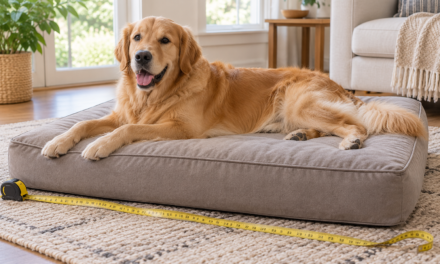
A soft crate can look roomy in a product photo and still be too low for your dog. Before comparing brands, make a short measurement record and check it against the exact model you plan to order.
The aim is enough usable space for your dog to stand, turn around, and lie down comfortably. Weight and breed labels can help you narrow a search, but they do not replace checking the fit.
1. Measure length and standing height
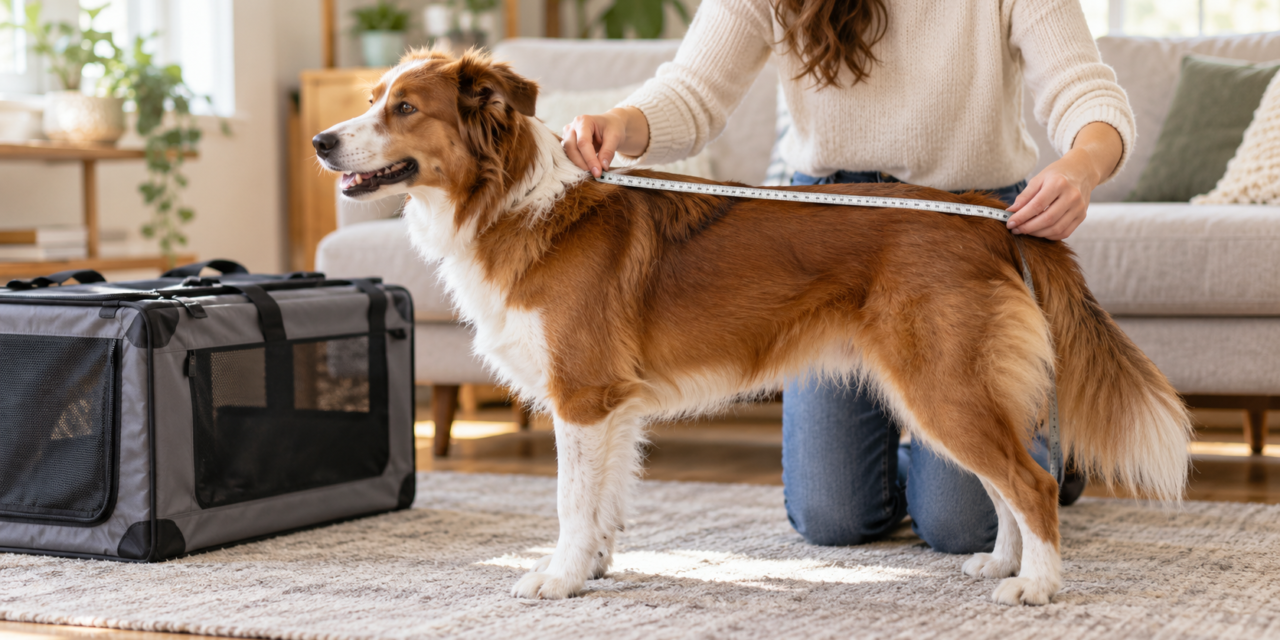
Use a tape measure while your dog is standing naturally. Record the length from the nose to the base of the tail, then the height from the floor to the top of the head. Repeat the measurements if your dog moves, and write down the units.
MidWest’s crate-sizing guidance recommends allowing extra clearance beyond those measurements. Follow the sizing instructions for the specific crate you select rather than treating one allowance as universal.
2. Read all three dimensions
A listing described as “36-inch” usually highlights one dimension. It does not tell you the width or height. Two crates with the same advertised length can have different proportions.
Record length, width, and height separately. Check whether the measurements describe the outside of the crate or the usable interior. If that is unclear, ask the manufacturer before buying, especially when your dog’s measurements are close to the stated limits.
3. Check the exact size and variant
Size names are not a common measuring system. For example, Feandrea’s collapsible crate listing labels its 24 x 16.5 x 16.5-inch option M. Another manufacturer’s “medium” may have different dimensions.
When you change a size or color on a shopping page, check the selected model and its dimensions again. Save the model identifier with your measurements so you can find the same version later.
4. Plan for bedding, the doorway, and the room
A thick pad takes up vertical space. Consider the bedding you intend to use when checking headroom, and check the doorway measurements if the entrance looks narrow.
Also measure the place where the crate will stand. A side-opening door is useful only if you can actually reach it. For storage, check the folded dimensions and whether the carrying bag is included.
5. Check suitability as well as size
The right dimensions do not make every soft crate suitable for every dog. MidWest’s soft-crate instructions, for example, specify use after crate training and warn against use with dogs likely to chew the fabric.
If your dog regularly bites or claws at an enclosure, resolve that suitability question before choosing a fabric model. For a different enclosure type, you can compare our plastic dog crate guide.
Before you order
- Record your dog’s length and standing height.
- Confirm the exact model, size, and all three crate dimensions.
- Check clearance, bedding, door access, and care instructions.
- Make sure a soft enclosure suits your dog’s behavior.
With those details ready, use our soft dog crate comparison to compare access, portability, and cleaning features.