The-Hunting-Dog is supported by its audience. We may receive commissions on purchases made from links on our site.
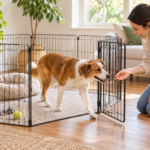
A dog exercise pen can give your companion a defined place to rest while keeping everyday household hazards out of reach. It works best when the dog learns that the space predicts comfortable, pleasant experiences—not when a gate suddenly closes and the family disappears. A good setup also depends on the dog: a quiet puppy, a determined climber, and a strong adult may need very different arrangements.
Use this guide to choose a location, introduce the pen in small steps, and recognize when the arrangement needs to change. For a comparison of panel styles and features, see our portable dog fence buying guide.
Start with a suitable space and a realistic plan
Pick a quiet area where you can see and hear your dog, away from busy doorways, stairs, heaters, cords, and anything that could fall into the enclosure. A corner of a family room often works better than an isolated room because a dog can settle near normal activity. Leave enough clearance around the outside that a curious muzzle cannot reach a cable, curtain, plant, or table leg.
Place the panels on a level surface. Check that each connection is seated and the door latches fully. Arrange the pen according to its instructions; a very long, narrow shape may be easier to push out of position than a compact closed shape. If using a floor protector, choose one that stays flat and is appropriate for your dog’s chewing habits. Test the setup with gentle pressure from several directions before inviting the dog in.
Allow room to stand, turn, stretch, lie comfortably and reach water without standing on bedding. A playpen is a management tool, not a substitute for walks, training, social contact, toilet breaks, or exercise. If a dog jumps, climbs, pushes panels over, or panics when confined, a pen may not be the right solution. Discuss an alternative with a qualified, reward-based trainer or veterinarian.
Make a safety check before every session
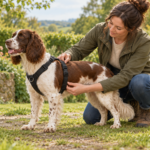
Inspect bars, joints, doors and fasteners for sharp edges, damage or openings where a paw or head could become trapped. Remove collars, tags, harnesses and leads before the dog enters when the pen manufacturer instructs it: they can catch on the enclosure. Keep identification available for outings and refit it before leaving the protected area. Never attach a tether to the panels or leave a trailing leash inside.
Choose bedding and enrichment for the individual dog. A soft bed may suit a dog who leaves fabric alone; a puppy who shreds and swallows fabric needs another arrangement. Introduce a new chew or toy while watching closely, and remove it if it breaks or the dog tries to swallow pieces. Keep fresh water available in a stable bowl that the dog cannot easily tip; check it frequently.
Stay nearby and supervise, especially with puppies or more than one dog. Separate dogs if there is tension around food or toys. Do not assume a pen can keep another animal, a child, or wildlife out. If you cannot supervise the dog safely, make a different plan rather than relying on a portable barrier as a guarantee.
Introduce the pen with the door open
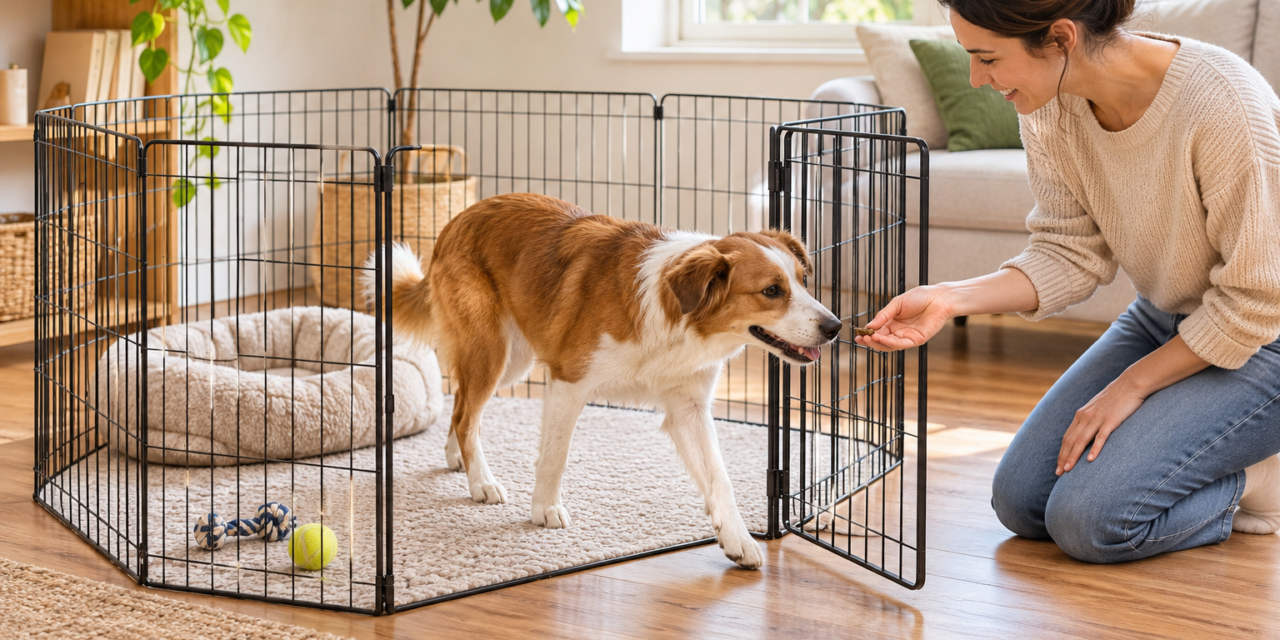
First let your dog investigate an assembled, stable pen without being shut inside. Scatter a few small treats just outside the entrance, then just inside. Allow the dog to enter and leave at their own pace. Praise calm exploration; do not drag the dog through the opening or use the pen as punishment.
Repeat several short sessions. When the dog readily steps inside, place a treat farther in or serve a meal in the pen with the door open. You can sit nearby and reward the dog for choosing to lie down. If the dog will not enter, move the food closer to the doorway and reduce distractions. The goal is a relaxed choice, not a race to close the gate.
Practice a brief closed-door session
Once the dog is comfortable going in, close the door for a moment while you remain beside it. Feed a treat through a safe opening, open the door, and let the dog leave. Repeat, gradually adding a few seconds only while the dog stays relaxed. Vary the length of repetitions so the door opening is not always preceded by a long wait.
Next, stand up, take a step away, return, and reward calm behavior. Gradually build distance and duration separately: do not introduce a longer absence and a new room at the same time. For a puppy, plan toilet breaks and naps around normal routines. A session can be finished after a few successful repetitions; there is no universal number of minutes that suits every dog.
Watch the whole dog. Loose posture, normal breathing and the ability to eat or rest can indicate the exercise is manageable. Repeated jumping, frantic scratching, persistent vocalizing, drooling or refusal of a familiar treat can indicate distress. Return calmly, open the pen, and make the next session easier. Do not wait for escalating panic to stop before helping. Persistent distress or risk of injury warrants professional advice.
Use the pen during ordinary routines
After practice, put a familiar mat inside and offer a meal or an appropriate food puzzle while you remain in the room. Let the dog out for a toilet break, a walk, and social time before returning to the pen. Try it when the dog is naturally ready to rest, rather than when they have pent-up energy. Keep a predictable routine, but do not require a dog to remain confined beyond their comfort or physical needs.
If visitors are arriving, set up well before the doorbell rings. Give your dog space away from reaching hands and instruct visitors not to crowd the pen. A barrier is not a substitute for adult supervision of children and dogs. When your dog is calm, you can decide whether a controlled introduction outside the pen is appropriate.
Taking a portable pen outdoors
Check local rules and the site before unpacking. Select level ground away from traffic, cooking equipment, poisonous plants, standing water and places where stakes or panels could create a trip hazard. Provide shade and fresh water, remembering that shade moves as the sun changes. Bring the dog inside if weather, heat, insects or the dog’s behavior makes the area uncomfortable.
Use only the anchors and assembly method intended by the manufacturer, and check that the surface can hold them. Stakes can loosen in soft ground, and a determined dog may still push, climb or dig out. Keep the dog under direct supervision. A portable pen does not prevent another dog or wildlife entering, and it should not be used as a secure unattended campsite fence. For transitions to and from the pen, use an appropriate lead and refit identification before opening the enclosure.
Example: a folding wire pen
The MidWest 30-inch exercise pen with door, model 552-30DR, is one option in our comparison. Its eight connected panels fold for storage and the door gives access without lifting a dog over the side. The manufacturer’s instructions warn owners to remove collars, tags and leads before use. Its 30-inch height is a physical limit, not a promise that a particular dog cannot climb or jump out; observe your dog and choose another arrangement if needed.
See the MidWest Exercise Pen on Amazon
Common problems and practical adjustments
The pen moves: Check that all panels are joined correctly and use manufacturer-approved stabilizers or anchors where appropriate. On a smooth indoor floor, a suitable non-slip surface may help, but do not improvise attachments that introduce sharp parts or damage a rental. If the dog can move the pen despite a correct setup, use a more appropriate space.
The dog chews the panels: Interrupt gently, offer a suitable alternative while supervising, and make sessions shorter. Check for damage immediately. If chewing continues, particularly on plastic or coated parts, stop using that pen and seek guidance; swallowed fragments can be dangerous.
The dog whines as you leave: Check for a toilet need, discomfort or a setup problem first. Return to a shorter, easier step with you nearby and reward calm behavior. A dog who becomes very distressed when separated may need an individual plan from a veterinarian or qualified behavior professional.
The dog keeps climbing: Stop the session before an escape or fall. Increasing height is not a reliable solution for every dog, and a cover must be specifically compatible and used according to the manufacturer’s instructions. A secure room or another supervised arrangement may be safer.