2026’s Best Underground Dog Fences
The-Hunting-Dog is supported by its audience. As an Amazon Associate, we earn from qualifying purchases.
Want to keep the view across your yard while comparing a wired dog boundary? The right kit starts with the route you need to cover, the wire supplied and the collar’s fit. Here’s what the main systems offer.
Underground dog fence comparison
| Model | eXtreme Standard | PetSafe Rechargeable | SportDOG SDF-100C | PetSafe Basic | PetSafe Stubborn Dog |
|---|---|---|---|---|---|
| Preview |
 |
 |
 |
 |
 |
| Title | eXtreme Dog Fence Standard | PetSafe Rechargeable In-Ground Fence | SportDOG Rechargeable In-Ground Fence | PetSafe Basic In-Ground Fence | PetSafe Stubborn Dog In-Ground Fence |
| Battery | Replaceable collar battery; not rechargeable | Rechargeable; 2–3 hr charge; up to 2 months | Rechargeable Li-ion; 2 hr charge; 1–2 months stated | RFA-67, 6V replaceable; included | 1 × 9V alkaline; included |
| Water Resistance | Waterproof receiver; keep transmitter dry | Waterproof receiver; indoor transmitter | Receiver submersible to 25 ft | Waterproof receiver; protected transmitter | Waterproof receiver; indoor transmitter |
| Correction Type | Tone and static | Tone and static | Tone, vibration and static | Tone and static | Tone + vibration; static |
| Correction Levels | 7 static levels + tone-only | 4 static levels + tone-only | 7 static levels | 4 static levels + tone-only | 4 static levels + tone/vibration mode |
| Number of Flags | 50 | 50 | 100 | 50 | 50 |
| Min Dog Weight | 8 lb in listing; fit and behavior still matter | 5 lb; 6–26 in neck | 10 lb; listing neck range 8–28 in | 8 lb; 6–26 in neck; 6 months+ | 8 lb; 6–28 in neck; 6 months+ |
| Coverage Area | Maker pages differ: 2 / 25 acres* | About 1/3 acre supplied; up to 25 with extra wire | 1 1/3 acres supplied; up to 100 with extra wire | About 1/3 acre supplied; up to 5 with extra wire | About 1/3 acre supplied; up to 25 with extra wire |
| Wire Length | 500 ft; 20 gauge | 500 ft; 20 gauge | 1,000 ft | 500 ft | 500 ft; 20 gauge |
| Contact Points | Medium and long in Standard kit* | Short and long | Standard and longer contacts | Short and long | Short installed; long supplied |
| Prime Benefits | Offer dependent | Offer dependent | Offer dependent | Offer dependent | Offer dependent |
| Customer Rating | No current rating displayed | No current rating displayed | No current rating displayed | No current rating displayed | No current rating displayed |
| More information | Check priceFull review | Check priceFull review | Check priceFull review | Check priceFull review | Check priceFull review |
*eXtreme’s Standard collection states up to 25 acres, while its system comparison states two; a consistent maximum is not established. The current Standard kit specifies medium and long contacts, while other maker labels use short/long terminology. SportDOG’s selected title and manufacturer specification describe one collar; an Amazon bullet refers to two. The comparison uses the one-dog SDF-100C kit. Coverage and battery figures are manufacturer claims, and expansion requires additional materials.
Underground dog fences: the basics
An in-ground system sends a radio signal along a wire loop. A compatible collar responds near that loop with a warning and, depending on its setting, static stimulation. The wire does not create a wall. A dog can cross it, a power failure can disable it, and another dog or person can enter the yard.
These systems therefore need a different decision from choosing a physical fence. AVSAB recommends reward-based training and advises against aversive methods, including electronic collars. Our comparison explains the hardware; it does not treat a shock boundary as the preferred way to teach a dog where to stay. A suitable physical fence, supervision and reward-based training remain our starting point.

Before purchasing materials, use our guide to planning an underground dog fence layout before digging. It covers the complete circuit, usable space, utility marking and the difference between a wire-length requirement and an acreage claim.
Guide contents
Underground Dog Fence Reviews
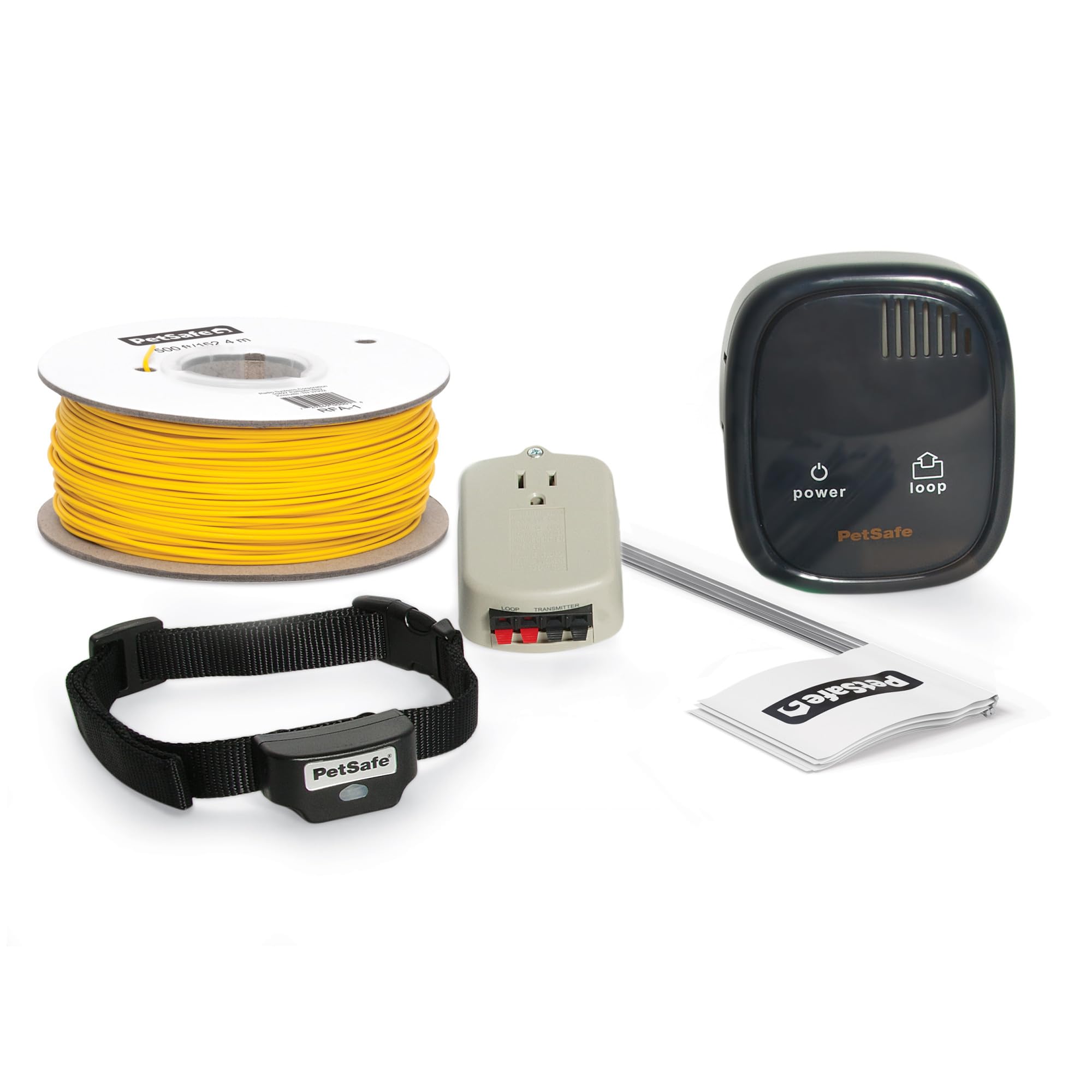
1. PetSafe Rechargeable In-Ground Fence
PIG00-14673 · 1 rechargeable collar · 500 ft · 20-gauge wire kit
The PetSafe Rechargeable kit is the choice to compare if replacing small collar batteries would be inconvenient. Its receiver charges in two to three hours, with a stated maximum of two months between charges depending on use. The transmitter still needs mains power: rechargeable refers to the collar, not an off-grid fence. The included 500 feet of wire is intended for about one-third of an acre, with extra wire required for expansion up to the maker's 25-acre limit.
This PIG00-14673 package includes one waterproof receiver, a charger, a surge protector, 50 flags and short and long contacts. The collar fits necks from six to 26 inches and is listed for pets weighing at least five pounds. Those figures distinguish its fit range from the Stubborn Dog kit's larger neck range; they do not establish that an electronic boundary is appropriate for a small, anxious or reactive dog.
Four adjustable static levels and a tone-only mode describe the available outputs. They are not evidence of reliable containment under every distraction. Extra compatible in-ground receivers can share the system, but YardMax and UltraSmart collars are excluded. Compared with the Basic kit, the practical gains are rechargeable power and a higher expansion ceiling. The compromises are keeping a charging routine and relying on an electronic warning instead of a physical barrier.
Pros
- Rechargeable receiver with a documented two-to-three-hour charging time.
- 500 ft of wire, 50 flags, charger and surge protector included.
- 6–26 in neck range; expandable with compatible additional receivers.
Cons
- Collar must be charged and transmitter powered; incompatible with YardMax and UltraSmart receivers.
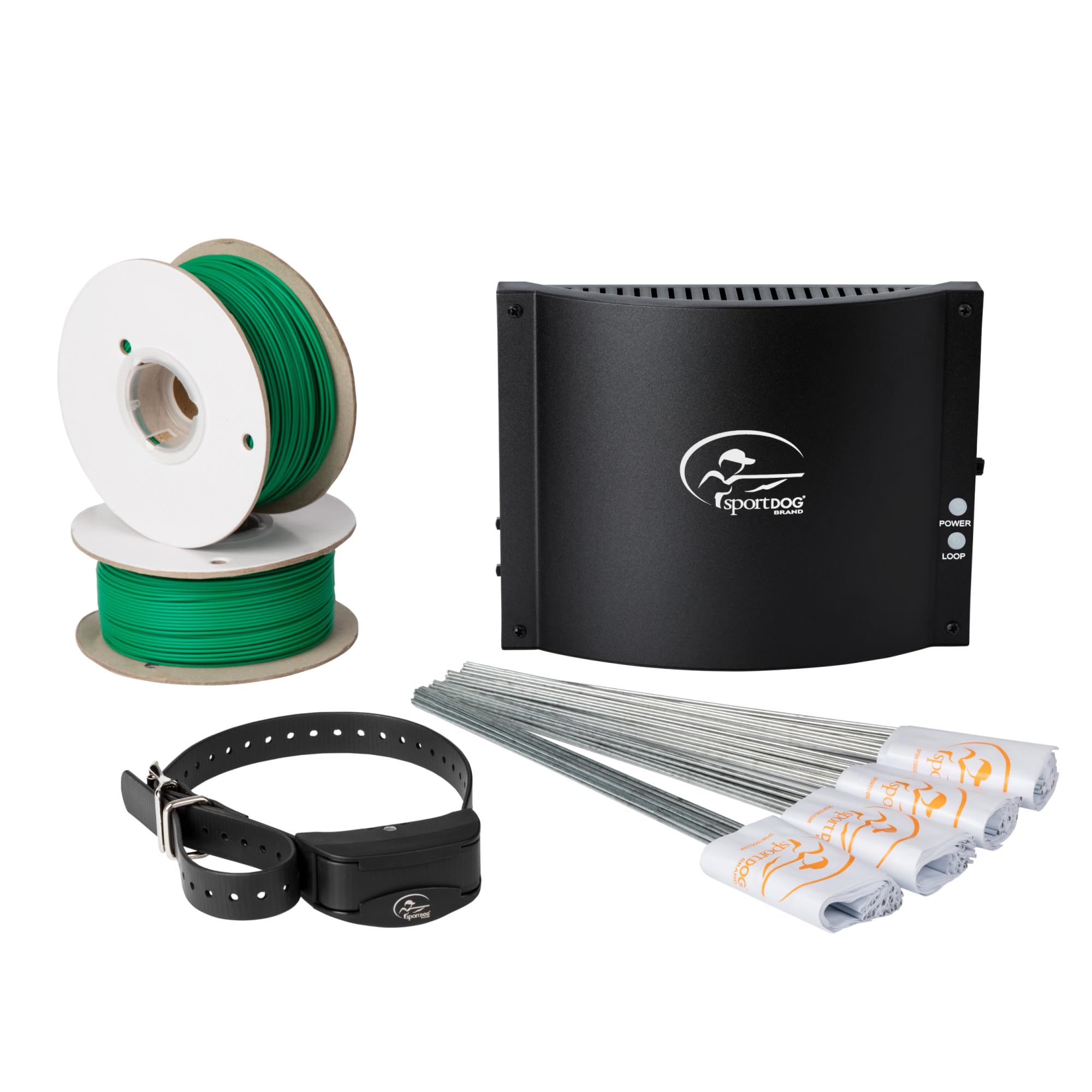
2. SportDOG Rechargeable In-Ground Fence
SDF-100C · 1 Dog System · 1,000 ft
SportDOG's SDF-100C is the larger starter kit here: 1,000 feet of wire and 100 flags provide a stated one-and-one-third-acre starting layout. The transmitter supports expansion up to 100 acres with additional wire and flags. That maximum is a system capability, not the area supplied in the carton. It is useful to compare for a long perimeter, although complex shapes and a double-loop design can use wire much faster than a simple acreage estimate suggests.
The rechargeable lithium-ion receiver takes approximately two hours to charge and has a stated one-to-two-month battery life. DryTek waterproofing is rated for submersion to 25 feet. SportDOG specifies dogs of at least ten pounds; the listing gives an eight-to-28-inch neck range. The manufacturer describes the SDF-100C starter system with one receiver, consistent with the selected '1 Dog System' title. A listing bullet refers to two collars, so that bullet should not be treated as a promise of a second receiver.
Tone, vibration and seven static levels are available. Longer contact points are supplied for a thicker coat. Extra SDF-CR receivers let more dogs share the boundary, with each receiver bought separately. Its larger wire supply and rechargeable power distinguish it from the smaller PetSafe starter kits; the corresponding workload is a longer installation and continued checks of wire, battery and fit. More stimulation settings do not make it a solution for fear, aggression or escape chasing.
Pros
- 1,000 ft of wire and 100 flags included; more than the 500-ft kits.
- Two-hour charging and stated one-to-two-month receiver runtime.
- Receiver has a specific 25-ft submersion rating.
Cons
- Large-acreage expansion needs extra materials; listing has conflicting one/two-collar wording.*
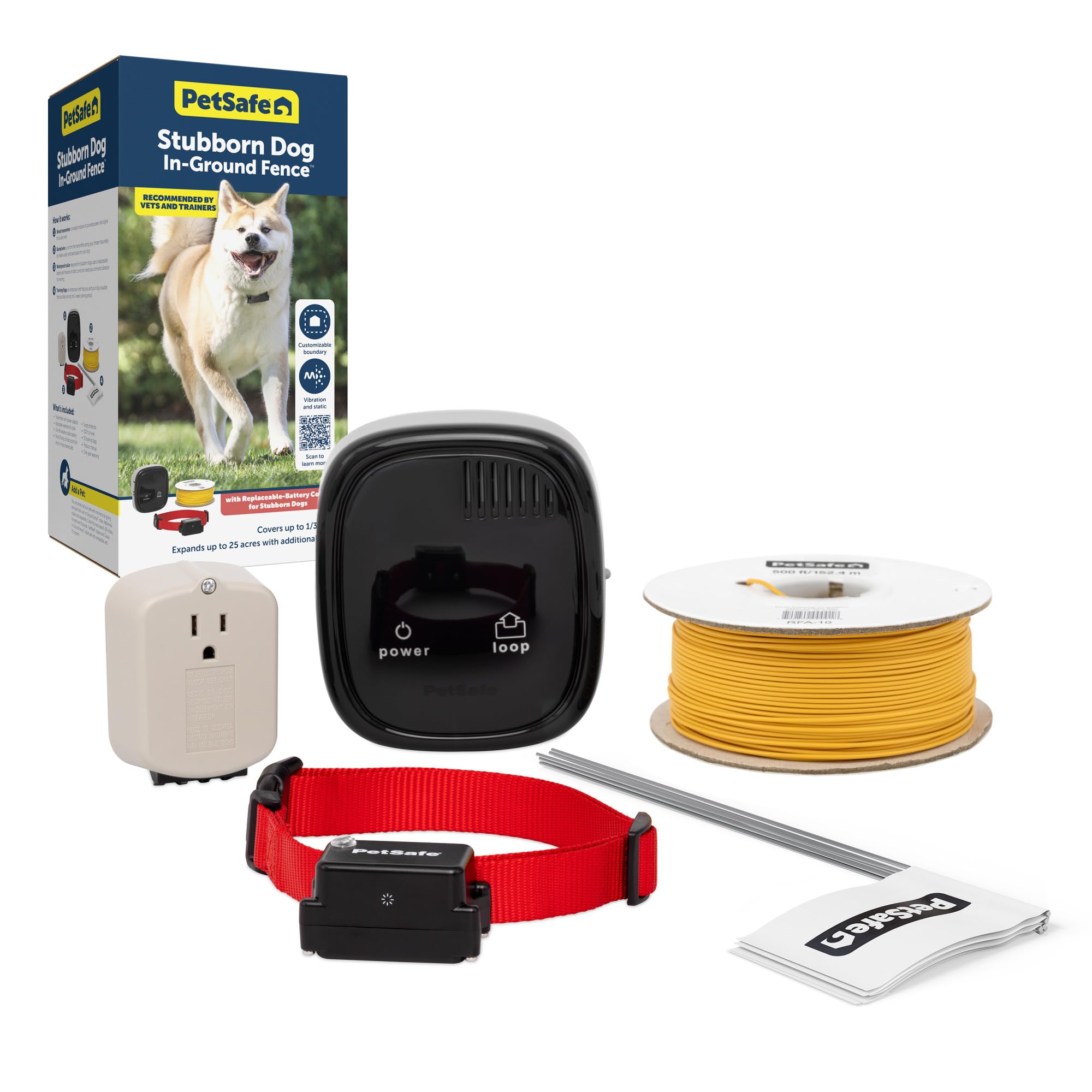
3. PetSafe Stubborn Dog In-Ground Fence
PIG00-10777 · 1 collar · 500 ft / 1/3 acre · 20-gauge wire kit
This PetSafe kit differs from the Basic model through its receiver outputs and larger expansion capacity. It combines a tone-plus-vibration mode with four static levels and includes 500 feet of wire for about one-third of an acre. Additional wire can extend the system up to 25 acres. The product name describes its marketing position; it is not a diagnosis of why a dog leaves the yard or a reason to escalate punishment.
The waterproof receiver uses an included nine-volt alkaline battery and fits a six-to-28-inch neck. PetSafe specifies dogs weighing at least eight pounds and aged six months or older. The package includes 50 flags, a transmitter and power adapter, plus a surge protector. Short contacts come installed, with longer contacts supplied. Its neck range is slightly broader than the Basic kit's, and its replaceable power source avoids scheduling collar charging.
There are practical limits to those distinctions. Vibration can also be unpleasant; it should not automatically be described as a humane training method for a deaf dog. A nine-volt battery must be replaced, and the receiver's waterproofing does not make the indoor transmitter weatherproof. The operating guide requires boundary checks without the collar on the dog and daily inspection of the contact area. Compared with a physical fence, this remains a warning-and-correction system that cannot block visitors or guarantee containment.
Pros
- 500 ft of wire, 50 flags and a surge protector included.
- Common nine-volt replaceable receiver battery supplied.
- 6–28 in neck range and expansion to 25 acres with additional wire.
Cons
- Aversive tone/vibration/static operation; the 'Stubborn' label does not make stronger correction appropriate.
4. eXtreme Dog Fence Standard
Standard · 1 dog · 500 ft · 1D500FT
The Standard eXtreme kit suits an owner comparing a configurable wired layout with the convenience of a digital transmitter. This selection is the one-dog, 500-foot package, not a Pro, Max or multi-dog bundle. Its 20-gauge boundary wire has a polyethylene coating; the manufacturer's Standard kit includes 50 flags, waterproof splices and a waterproof receiver. The heavier wire and separate surge protector supplied with higher grades should not be assumed to come with this package.
The receiver uses a replaceable battery rather than charging on a cradle. The manufacturer's comparison lists seven static levels and tone-only operation. Its Standard product page specifies medium and long contacts, while accessory labels elsewhere use short and long terminology. The important distinction is that more than one contact length is supplied; that does not remove the need to avoid pressure injury or establish that correction is comfortable.
Capacity claims need particular care. The maker's Standard collection advertises properties up to 25 acres, while its system comparison lists two acres. We would not budget a large installation around the higher claim. Measure the complete wire route, including the return to the transmitter, and allow for the boundary field. This kit offers layout flexibility, but it supplies neither a physical barrier nor protection against animals entering the yard.
Pros
- Digital transmitter with multiple-frequency selection and wire-check features.
- 500 ft of 20-gauge wire, 50 flags and waterproof splices in the Standard kit.
- Several collar and wire-length configurations are available as separate variants.
Cons
- Manufacturer acreage claims conflict; replaceable collar battery and no separate surge protector in the Standard kit.
5. PetSafe Basic In-Ground Fence
PIG00-14582 · 1 collar · 500 ft · 1 Count (Pack of 1)
The Basic PetSafe kit is the straightforward option for a smaller wired layout. It includes 500 feet of boundary wire for about one-third of an acre, and the transmitter can cover up to five acres with extra wire. That lower expansion ceiling matters if you are comparing it with the 25-acre PetSafe models or the SportDOG system. For a compact yard, however, measuring the actual route is more useful than buying the largest advertised acreage.
The included Deluxe UltraLight receiver uses a replaceable RFA-67 six-volt battery, with the initial battery supplied. It is waterproof, fits a six-to-26-inch neck and is intended for dogs weighing at least eight pounds and aged six months or older. The kit has 50 flags and short and long contacts. Its tone-only mode and four static levels give different output settings; they do not create a solid obstacle at a driveway or gate.
Compared with the rechargeable PetSafe, this model avoids a charging cradle but commits you to replacement batteries. Additional compatible receivers can share the loop, although compatibility must be with an in-ground system rather than a similarly named wireless collar. Keep the transmitter protected from weather, and test the boundary with the dog elsewhere before burying the wire. This kit is chiefly a simpler hardware package, not an assurance that a dog will remain in the yard.
Pros
- Defined smaller-yard package with 500 ft of wire and 50 flags.
- Waterproof receiver and included replaceable RFA-67 battery.
- Extra compatible receivers can share the same loop.
Cons
- Five-acre expansion ceiling; replacement batteries and mains-powered transmitter required.
Factors to consider when choosing an underground dog fence
Covered area and supplied wire
A transmitter’s maximum acreage assumes additional materials and an appropriate layout. The starter kit’s spool is a separate limit. Four of these variants supply 500 feet, while the SportDOG supplies 1,000. A double loop, irregular perimeter, internal exclusion or long connection to the transmitter can consume more wire than a simple acreage estimate suggests.
Measure the complete circuit, including the return, before deciding which package fits. Allow room for the signal field inside the wire: a narrow strip between a building and a boundary may leave too little comfortable space for a dog. Larger expansion figures do not compensate for an unsuitable layout.
Type of correction and suitability
Tone, vibration and static are different outputs, not three proven levels of humane training. A sound or vibration can become aversive, particularly when it predicts an unpleasant consequence. More static levels give a hardware adjustment; they do not diagnose chasing, fear or distress. Do not choose a stronger unit as the answer to a dog who has already crossed a boundary.
A fearful, reactive or aggressive dog needs an individual behavior plan. The PetSafe and SportDOG operating guides specifically warn against using these systems with aggressive dogs. Quietness or reluctance to enter the yard should not be mistaken for successful training. If a dog avoids the garden, freezes or becomes distressed, stop and seek veterinary or qualified behavior help.
Waterproof receiver, protected transmitter
A waterproof collar rating applies to the receiver, not automatically to the wall unit, adapter, connectors or charger. The SportDOG publishes a 25-foot submersion rating; the PetSafe descriptions identify waterproof receivers without that same depth claim. Do not transfer a rating between brands or from one version of a product to another.
Collar size and contact points
Neck measurements are circumferences, not diameters. Compare both the weight threshold and the actual neck range. The rechargeable PetSafe lists five pounds and six to 26 inches; the Basic starts at eight pounds, and SportDOG at ten. These are manufacturer fit limits, not assurances about suitability for every dog above that weight.
Longer contacts accommodate a thicker coat, but tightening a strap excessively is not a substitute for correct fit. PetSafe’s instructions call for daily checks for skin irritation, regular cleaning and removing the collar if sores develop. Do not attach a leash to an electronic receiver collar. Use an appropriate separate walking attachment.
Battery and ongoing care
Decide whether you prefer replaceable receiver batteries or a charging routine. The Basic uses an RFA-67 battery; Stubborn Dog uses a nine-volt alkaline; eXtreme Standard uses a replaceable receiver battery. The two rechargeable systems have stated runtimes of up to roughly one or two months depending on the model and use. Those figures are maxima or ranges, not a schedule that eliminates battery checks.
All five transmitters need power. Keep physical containment available during charging, electrical interruptions or repairs. Inspect accessible wire, splices and the transmitter’s loop indicator, especially after garden work. Test equipment with the dog elsewhere and the receiver off the dog, including after changing the boundary field.
Advantages of a wired layout
A buried-wire route can follow an irregular property more closely than a circular radio boundary. It can also define exclusion areas when the complete circuit is designed correctly. The lack of visible panels may suit some properties, and compatible extra receivers can let several dogs use the same installed loop.
Those are hardware and appearance advantages. They do not establish a lower total price in every yard, remove local requirements or create the security of a solid barrier. Budget for wire, splices, utility locating where needed, installation, batteries or charging, and future repairs as well as the starter kit.
Drawbacks and installation limits
Installation requires planning, a continuous wire circuit and testing before burial. A break or damaged splice can interrupt operation. Surface wire must be protected from mowing and trip hazards; an indoor transmitter needs a suitable dry mounting position. Do not plan installation during a storm or use electrical equipment outdoors contrary to its rating.
Contact 811 or your state 811 center before any digging in the US, then wait for the required responses and follow its instructions. Privately owned lines may require separate locating. A shallow pet-fence trench does not establish that buried utilities are out of reach. The system’s own wire plan cannot replace utility marking.
The biggest limitation is behavioral: a dog can run through the field, and the system cannot stop a person, wildlife or another dog entering. A dog outside the boundary also needs a safe recovery plan. Do not assume that every receiver allows correction-free re-entry; that feature must belong to the exact model.
Underground dog fence vs wireless dog fence vs regular fence
Regular physical fence
A suitable physical fence provides an actual obstacle and can restrict access by outside animals. It still needs secure gates, appropriate height and attention to digging or climbing. Privacy panels can reduce views of passing triggers where appropriate. For most owners seeking dependable everyday containment, this is the first option we would assess.
In-ground electronic fence
A wired system follows a chosen route and leaves the view open, but it relies on a powered loop, a working receiver and the dog’s response. It does not physically close a driveway. It is also a permanent installation project compared with a portable exercise pen. Comparing wire lengths and collar features is useful only after considering those limits.
Wireless electronic fence
Traditional radio wireless systems generally create a circular area around a transmitter, while GPS systems use a different positioning method. Neither category should be assumed to share the accuracy, fit or re-entry behavior of another product. Our wireless dog fence guide separates those designs and their limitations.
Common questions
Does 500 feet of wire cover a 25-acre yard?
No. A 25-acre figure is an expansion claim for some transmitters, requiring substantially more wire. Layout shape matters too. A 100-by-80-foot rectangle alone needs 360 feet around its perimeter, before connecting runs and other allowances. Measure your route rather than equating a spool length with the maximum acreage on the box.
Will a buried fence stop every escape?
No. It is a deterrent rather than a solid barrier. Distractions, equipment faults, battery condition and the dog’s response can all affect containment. Keep identification current and maintain a physical containment option; do not rely on a receiver to protect a dog from traffic.
Can any extra collar work with any transmitter?
No. Similar branding is insufficient. PetSafe’s in-ground compatibility excludes certain ranges such as YardMax and UltraSmart, while wireless receivers use a different system. SportDOG specifies SDF-CR extra receivers for SDF-100C. Match the exact system rather than buying by collar appearance.
 Wireless dog fence guide
 Portable dog fences
 Remote collar comparison