Best Bark Collar Reviews
If you’re a dog owner, there’s a good chance you’ve dealt with barking at one time or another. Maybe you have a new puppy who barks when someone comes to the door, or a dog who rushes to the window every time a person walks by. Those situations can look similar from the outside, so start by figuring out what sets your dog off. If you’re looking at bark collars, pay close attention to what each model detects and what it does in response. A tone, vibration, and an electrical pulse are different experiences for your dog.

Compare five bark collars
| Model | Garmin BarkLimiter Deluxe | SportDOG NoBark SBC-10 | Educator BarkLess Pro | SKBAK Black Pro | StopWoofer |
|---|---|---|---|---|---|
| Images |  |
 |
 |
 |
 |
| Response | Vibration or electrical stimulation | Electrical stimulation | Tone only or electrical stimulation | Tone, vibration, both, or both plus electrical stimulation | Tone only or tone with vibration |
| Response settings | 7 fixed electrical levels and AutoRise | 10 levels across 2 electrical programs | 8 fixed electrical levels and Auto (L9) | 4 listed responses | 2 listed responses |
| Bark detection | Throat movement and vibration | Silent Partner detection | Vibration sensor, 3 sensitivity levels | Sound and motion sensors, 8 sensitivity levels¹ | Automatic detection¹ |
| Battery | Replaceable rechargeable lithium-ion | Rechargeable lithium-ion | Rechargeable lithium polymer | 15–20 days per charge¹ | Up to 14 days per charge¹ |
| Full charge | About 2 hours | About 2 hours | About 2 hours | About 2 hours¹ | Charge time unstated¹ |
| Water resistance | IPX7 | DryTek, rated to 25 ft | Waterproof per manufacturer | IP67¹ | IP67¹ |
| Neck fit / strap | 6–27 in at Chewy³ | 5–22 in | 30 in cut-to-fit strap¹ | Up to 25 in¹ | 6–19.7 in² |
| Dog weight | Minimum unstated | 8 lb and up | Minimum unstated | 10–100 lb¹ | 5–120 lb² |
| On-device tally | Bark detections since power-on | No tally in manual | Stimulation activations | Bark counter¹ | No tally in listing |
| Amazon | Check price | Check price | Check price | Check price | Check price |
| Review | Full review | Full review | Full review | Full review | Full review |
What is a bark collar and how does it detect barking?
Depending on the model, a sensor responds to sound, movement or vibration near the throat. The collar then applies the response selected by its program. Detection sensitivity controls when that response triggers. Output intensity controls the strength of the response on models that offer such a setting.

Read the entire mode description. A vibration warning can be followed by an electrical pulse. A model with an explicitly separate vibration-only mode gives a different response. Automatic settings can change output during an episode. Some counters track detections, while others track when the unit delivers a response.
Automatic bark collars and remote collars
An automatic bark collar uses its sensor to decide when to respond. A remote collar responds when the handler presses a button. The table compares automatic bark collars. For each model, check both the detection method and which output modes it actually offers.
Other bark collar designs
Bark collars also come in designs that use ultrasonic sound or spray. An ultrasonic collar produces a high-pitched sound. A spray collar releases a short burst of spray and has a reservoir you may need to refill. Vibration is felt through the receiver. These are different mechanisms, so check which one the maker means by a term such as “correction” or “warning.” VCA on bark-activated devices.
If you’re tracking window barking, write down whether it happens when someone walks by, when another dog appears, or when your dog can hear people they can’t see. That record gives you something to compare when you change the view from the window or practice moving away from it with a reward.
What to consider before buying
Identify the trigger first. Barking at passersby, barking to get attention, and barking when left alone can call for different changes. An automatic device responds to a signal and cannot identify the reason for the behavior. Sound or vibration can still startle a dog, and reducing barking alone does not tell you whether the dog is less distressed.
The American Veterinary Society of Animal Behavior recommends reward-based methods for behavior modification. If the trigger is movement outside, begin with the sightline and practice a different response. Our step-by-step guide to window barking covers both.

Fit for a small dog
Compare your dog’s weight and neck measurement with the range for the exact model. Check both limits, as an adjustable strap can fit around the neck even when the dog is below the maker’s stated weight range.
The models in detail
The BarkLimiter Deluxe, model 010-01070-10, is the rechargeable version of Garmin’s original BarkLimiter. That distinction matters when shopping for a used unit or replacement charger. The standard model takes a disposable CR2 battery. The Deluxe uses a replaceable rechargeable lithium-ion battery, and Garmin rates it for about three months of typical use. The device sleeps when it detects neither motion nor barking, so activity affects the time between charges. The manual also specifies IPX7 water resistance and about two hours to fully recharge the unit. The included strap’s fit is less clear. Chewy lists a 6–27-inch neck range, while Leerburg lists a maximum of 24 inches. Garmin’s manual describes how to check the fit and gives no numerical neck range.
The dial offers vibration as a standalone response and separates it from the electrical settings. That is a meaningful difference from the SportDOG SBC-10, whose two operating programs both deliver electrical stimulation. Garmin’s fixed electrical settings keep the output at the selected level. AutoRise changes it automatically as barking continues. The same collar can therefore behave very differently depending on the position of the dial. Vibration can still be aversive if it startles the dog.
The Bark Odometer gives this model a more useful status readout than a simple power light. Garmin says the flashes represent the barks detected since the unit was last switched on. Treat that total as the collar’s record. A count gives no detail about when each event happened, what was going on around the dog, or whether a detection was accurate. If you want to find out why your dog barks at the front window, an observation log or a short video gives you the context that the dial cannot show.
The Deluxe is easiest to distinguish from the other models here by its battery design, vibration setting and documented water rating. Its automatic electrical program remains an important limitation if you are trying to avoid a response that escalates without you present.
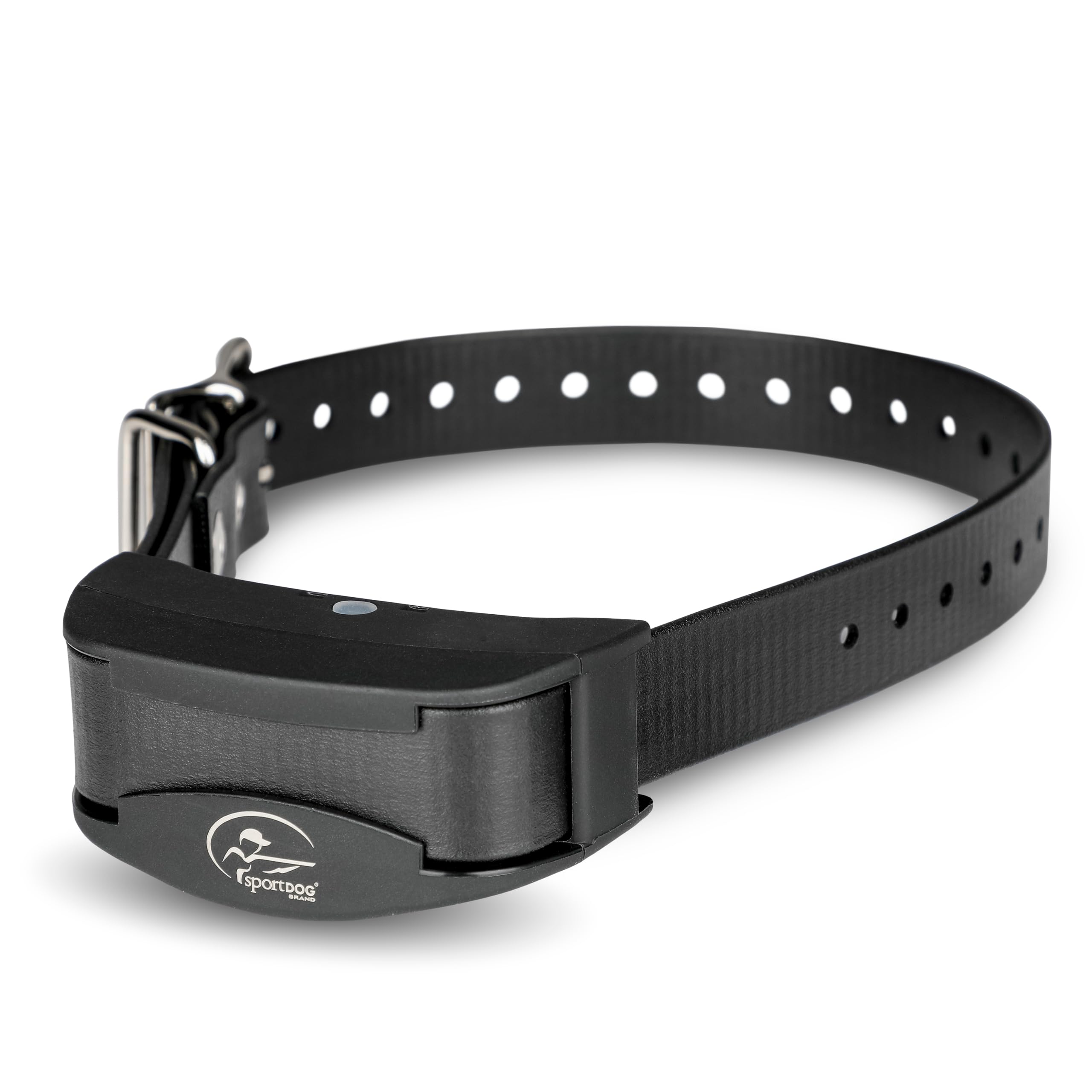
This is the complete rechargeable SportDOG NoBark SBC-10 collar. SportDOG lists a neck range of 5–22 inches and a minimum dog weight of 8 lb. Use those figures together when checking fit. A dog can fall within the weight guidance and still be outside the strap range. This model charges in about two hours with the included cradle, and the indicator distinguishes a low battery from a completed charge. If you are buying a used unit, check that the cradle is included.
Both operating programs use electrical stimulation. The factory default, Progressive Correction, starts at level one and can increase through ten levels if barking continues. The manual says it resets after a 30-second quiet interval. User Select keeps the output at a fixed selected level. The unit uses beeps as status signals, including during mode selection. Those beeps do not constitute an audible-only bark response. For that feature, the Educator has a separately documented mode.
SportDOG documents a temporary pause after a dense sequence of detections. The collar stops electrical output for 30 seconds if it detects at least 15 barks within 80 seconds, then resumes normal operation. That is a useful distinction from a product that gives no cutoff details. It is still a timer on the device. It gives no information about whether the dog is frightened or what is sustaining the barking.
The specifications make the SBC-10 easier to compare for fit and charging than models that rely on a seller graphic. The main trade-off is that its two choices change how the electrical output behaves. Shoppers looking for an audible or vibration-only response can rule this one out from the manual.
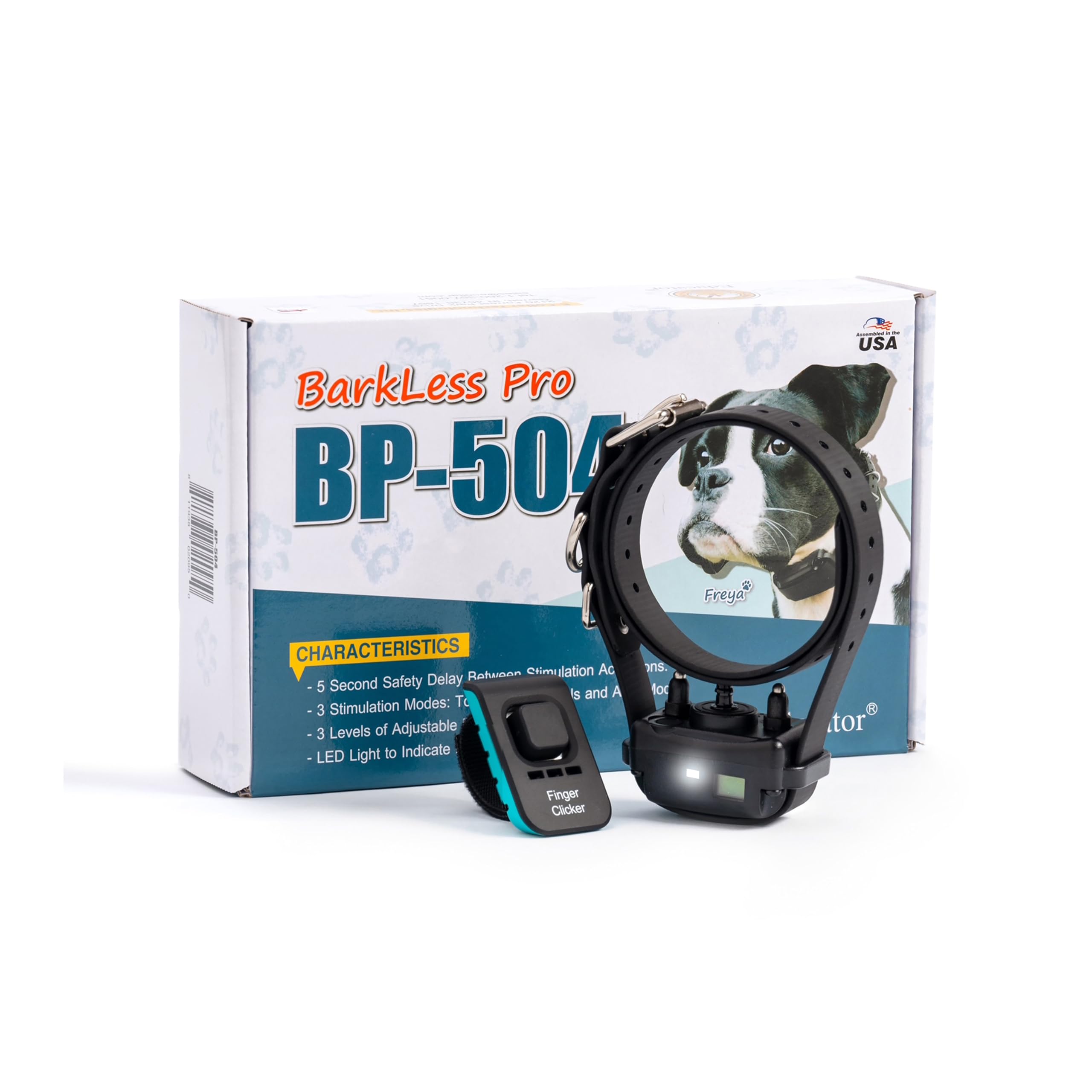
Educator’s BarkLess Pro is the BP-504 covered by the manufacturer’s manual. The Amazon listing uses the BP-504-C designation and gives a 30-inch cut-to-fit strap length. The strap length includes the portion used to secure the receiver and is different from a maximum neck circumference. Its main distinction is that detection sensitivity and the selected response are separate settings. The sensor has three sensitivity levels. The response menu includes a dedicated tone-only setting, eight fixed electrical levels and an automatic electrical program. The manual displays the automatic program as L9, which explains why some product descriptions refer to nine settings.
The distinction between sensitivity and output matters when comparing this with a collar that advertises a single number of levels. Sensitivity determines when the sensor registers a trigger. The response setting determines what the collar does after a trigger. The manual also describes an optional warning tone in the electrical programming. That feature is separate from choosing tone as the entire response. Both involve sound, but only the dedicated tone setting uses sound alone.
The display reports a count tied to stimulation activations. That makes it useful for checking how often the device has activated, with a different meaning from Garmin’s detection tally. It cannot be used as a complete count of a dog’s barks. The manual specifies a five-second delay between stimulation activations and lists short and long contact points among the supplied parts. It also gives roughly two hours for charging and describes the housing as waterproof.
The BP-504 gives a buyer more documented settings to compare than the simpler StopWoofer. Its automatic electrical program and optional warning tone make it especially important to read the selected mode in full. A mode name or the presence of a tone icon alone can give the wrong impression about the response.
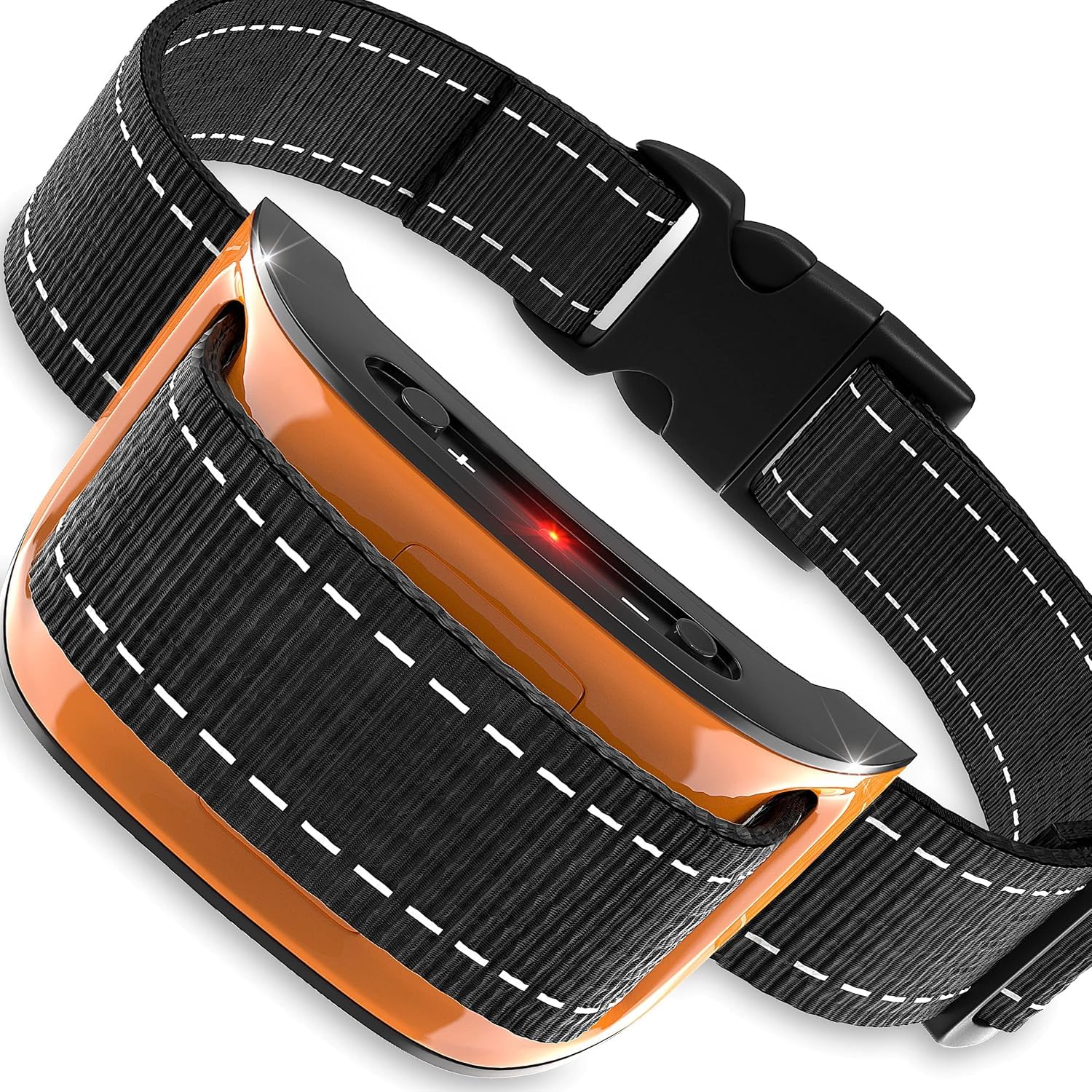
The SKBAK Black Pro, marked SM1013, has four responses in the seller’s product graphic. It shows a beep, vibration, a beep paired with vibration, and a fourth setting that adds an electrical pulse to the beep and vibration. This is the black Pro version. The distinction matters because a listing that puts the first three options front and center can make the fourth easy to miss. If you need a model without electrical output anywhere in its menu, the seller describes the orange StopWoofer differently.
The eight numbered settings in the graphic refer to how sensitive bark detection is. They give you information about the sensor controls, separate from the four response options. The weight figures on the pictured display refer to a setting shown on the unit. For fit, the written listing separately gives 10–100 lb and a maximum neck circumference of 25 inches. It gives an upper limit for the neck and leaves the minimum unstated.
The unit has a visible display the seller calls a bark counter. The seller also lists about two hours for charging, 15–20 days per charge and an IP67 water resistance rating. The product material reviewed here leaves the sensor’s accuracy and the counter’s exact trigger unclear. That makes the display more useful as an at-a-glance status feature than as a reliable way to measure how much a dog barked while you were away. Compared with Garmin or Educator, the biggest limitation is the amount of model-specific detail available on how to interpret what the unit shows.
This is the orange StopWoofer linked below. The seller describes two automatic responses, a tone by itself and a tone paired with vibration. Its FAQ says this version has no electrical output. That is the main difference from the SKBAK Black Pro, which includes an electrical option among its four modes. The StopWoofer seller does not list vibration alone for this variant. A dog can still find a sound or vibration startling, especially when it happens during an already stressful event.
The sizing graphic gives a recommended neck range of 6–19.7 inches and body weight of 5–120 lb for dogs over six months. The written listing gives a wider neck range and a different lower weight figure. Treat the more conservative sizing graphic as the reference for comparing models. If your dog’s neck is near the upper end, get confirmation for the exact orange version before buying. The total length shown on the strap graphic is a separate measurement.
The seller estimates up to 14 days between charges depending on use and lists an IP67 rating in the product title. The listing gives no specific time for a full recharge. That is a maximum estimate and is measured on a different basis from Garmin’s typical-use figure. The listing gives less detail about detection and fit than the manuals for the Garmin and SportDOG. The simpler response menu is easy to compare, but the inconsistent sizing information matters if you are shopping for a very small dog or are close to the upper fit limit.
When barking calls for a different plan
If barking starts suddenly or comes with a change in appetite, mobility or sleep, discuss the change with your veterinarian. Barking during absences, pacing and repeated attempts to escape can be signs of distress. A short recording of a normal absence can help a professional see what happens. For a predictable trigger at the window, changing the view and rewarding a move away from the glass gives the dog a behavior to practice.